
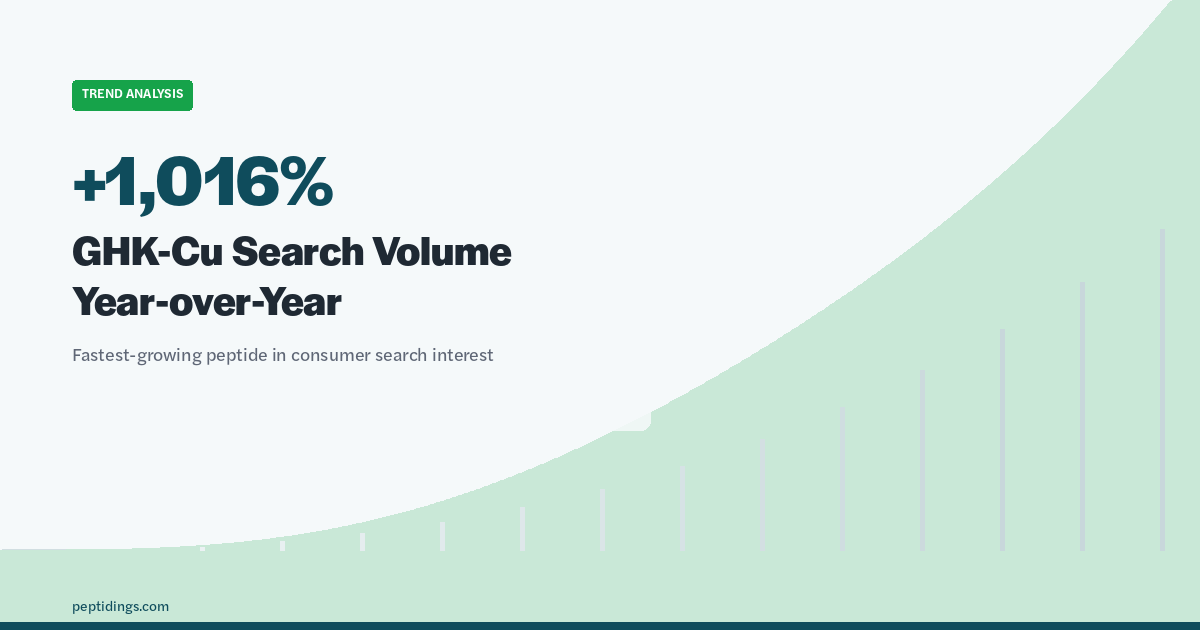
GHK-Cu is now the fastest-growing peptide in consumer search—and the gap between interest and evidence has never been wider.
Somewhere in the last 12 months, GHK-Cu went from “niche copper peptide that skincare enthusiasts know about” to “the peptide that everyone’s aunt is asking her dermatologist about.” Search volume for GHK-Cu grew 1,016% year-over-year—making it, by that measure, the fastest-growing peptide in the consumer information space, outpacing even BPC-157.
That’s a staggering number. It also creates a staggering opportunity for misinformation, because the evidence base for GHK-Cu is genuinely interesting but substantially narrower than the search volume implies.
What’s Driving the Surge
Three converging forces.
The anti-aging TikTok pipeline. GHK-Cu hit the influencer circuit hard in late 2025, primarily through skincare and “biohacking” content. The pitch is irresistible: a naturally occurring peptide that your body already makes, that declines with age, that promotes collagen synthesis and wound healing. Add copper’s association with cellular repair and you have a molecule that practically writes its own marketing copy. The problem is that the marketing copy and the published evidence are telling different stories at different volumes.
The topical-to-injectable migration. GHK-Cu has a legitimate, commercially available presence in topical skincare (serums, creams). But the search surge isn’t being driven by people looking for face creams—it’s being driven by people asking about injectable and subcutaneous GHK-Cu for systemic anti-aging effects. That’s a different claim, supported by a different (much thinner) evidence base, using a different route of administration. The leap from “topical GHK-Cu promotes wound healing in skin” to “injectable GHK-Cu is a systemic anti-aging intervention” is exactly the kind of inferential jump that Peptidings exists to flag.
The peptide mainstreaming wave. GHK-Cu is riding the same wave that put peptides on the front page of the Washington Post, CNN, and NBC in the last two weeks. As peptides enter mainstream consciousness—propelled by RFK Jr.’s reclassification push, the GLP-1 revolution, and wall-to-wall media coverage—search interest doesn’t distribute evenly. It concentrates on compounds that have the most compelling surface-level narrative. And “copper peptide that reverses aging” is about as compelling as surface-level narratives get.
What the GHK-Cu Evidence Actually Shows
GHK-Cu (glycyl-L-histidyl-L-lysine copper complex) is a naturally occurring tripeptide-copper complex first identified in human plasma in 1973. It’s present in blood, saliva, and urine, and its concentration does decline with age. That part of the story is real.
The research portfolio breaks down roughly like this:
Solid ground: Topical GHK-Cu promotes wound healing and collagen synthesis in human skin. Multiple studies support this, and commercial skincare products have been formulated around these findings for years. This is the evidence base that earns GHK-Cu its place in the conversation.
Interesting but early: In vitro studies show GHK-Cu upregulating genes involved in tissue remodeling, antioxidant defense, and anti-inflammatory pathways. A 2014 Broad Institute study identified GHK as a compound capable of modulating expression of a large number of human genes—a finding that generated significant excitement and a lot of extrapolation.
The gap: There are no controlled human trials of injectable GHK-Cu for systemic anti-aging, cognitive enhancement, or any of the other claims circulating in the self-experimentation community. The gene expression data is from cell cultures. The wound healing data is from topical application. The injectable use case that’s driving most of the search volume? That evidence base is preclinical and community-reported.
For the full evidence review, including evidence tier, mechanism of action, safety profile, and Claims vs. Evidence analysis, see our GHK-Cu compound article.
The Route-of-Administration Problem
This bears repeating because it’s the central issue: topical and injectable are not interchangeable evidence categories. When GHK-Cu is applied to skin, it acts locally on dermal tissue. When it’s injected subcutaneously, it enters systemic circulation and encounters a completely different pharmacokinetic environment—different bioavailability, different tissue distribution, different potential for off-target effects.
Using topical wound healing data to support injectable anti-aging claims is like using data showing aspirin treats headaches to argue that aspirin injections prevent heart attacks. The second claim might be true (and in aspirin’s case, something similar actually is), but the first data set doesn’t prove it. You need separate evidence for separate routes.
Most of the GHK-Cu content flooding the internet right now doesn’t make this distinction. We do.
What the Search Surge Means for Readers
If you arrived at Peptidings because you searched for GHK-Cu, here’s the honest summary: this is a genuinely interesting molecule with real science behind its topical applications, plausible mechanisms for broader effects, and almost no controlled human evidence for the injectable use cases that are driving the hype. That’s not a reason to dismiss it. It’s a reason to understand exactly where you’re standing on the evidence ladder before you make decisions.
The GHK-Cu compound article covers all of it—the science that exists, the science that doesn’t, and the difference between the two.
Read the full evidence review in our GHK-Cu compound article, or explore related compounds in the Skin Health and Anti-Aging research hub and our Tissue Repair and Recovery hub.
Peptidings reviews the evidence for 130+ peptide compounds across 19 research categories. Every compound article includes an evidence tier rating, verdict assessment, and Claims vs. Evidence analysis. No hype. No hedge. Just what the data shows.
This is what happened. Want to know what it means?
The Peptidings newsletter delivers evidence-based analysis of peptide news—every Monday morning. No hype. No hedging. Just the Dutch Uncle's honest take.